Dual-stage precision actuation system for thermomechanical measurements with expanded displacement range
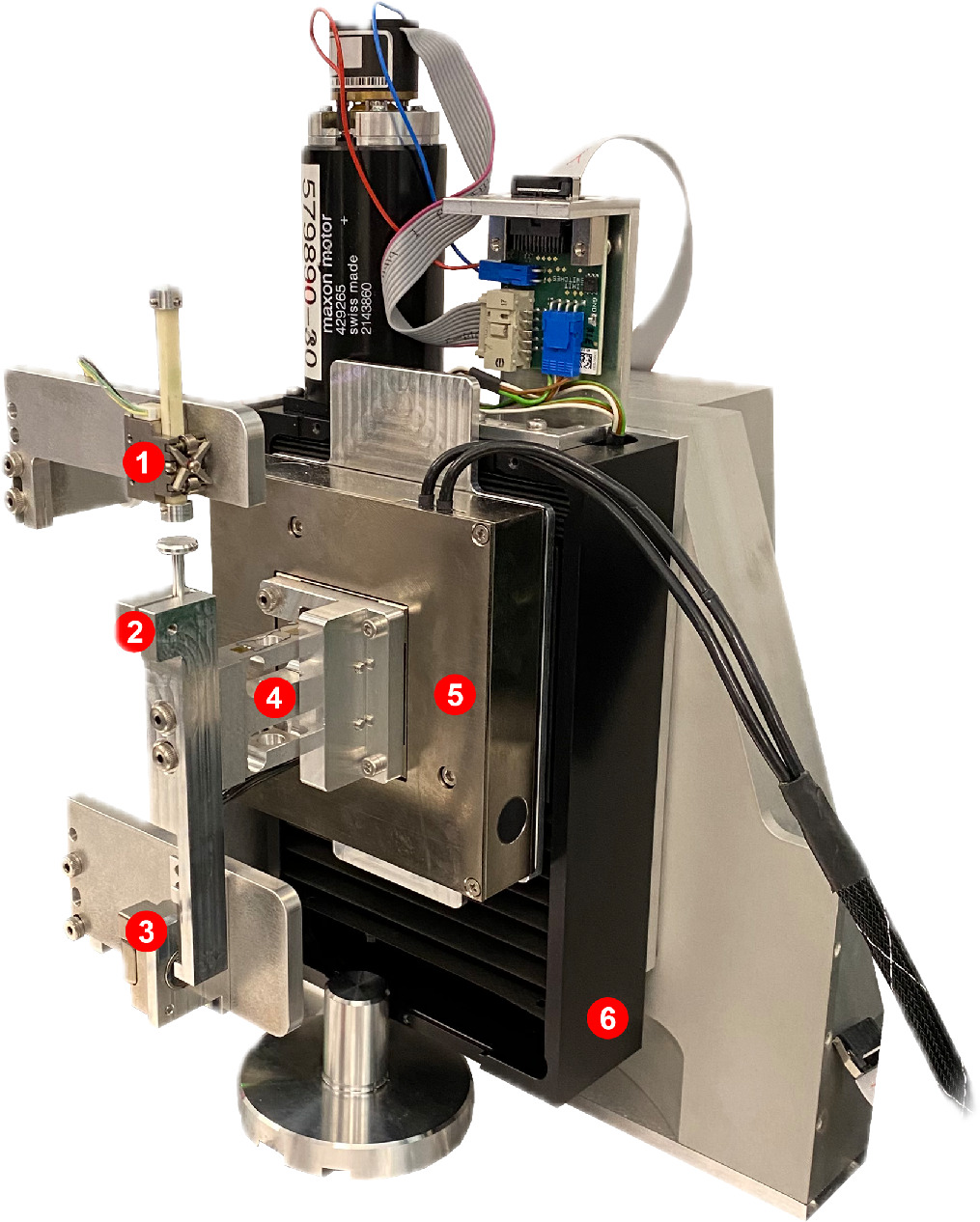
Overview
This case study presents a hybrid actuation approach for a thermomechanical analyzer (TMA) that extends the displacement range while maintaining high precision through a single, unified feedback loop.
Problem
Conventional TMA designs often involve trade-offs between long travel range and high resolution, may require manual adjustment to accommodate different sample sizes, and can introduce significant thermal-management complexity, especially when continuously powered voice-coil actuators are used.
Approach
The proposed concept uses a dual-stage (hybrid) actuation system: a coarse motor-spindle stage and a fine piezoelectric stage operate simultaneously. A load cell provides the feedback signal to maintain a constant force, while changes in sample length are measured optically using an optical encoder.
- Unified feedback controls both actuators: the piezo stage compensates for fast deviations, while a scaled correction signal slowly recenters the motorized stage.
- Expanded displacement range without sacrificing fine-stage resolution over the full measurement range.
- Reduced thermal complexity by avoiding a continuously powered force actuator as the primary force-generating element.
Validation
The concept was first validated using a simulated sample based on a piezo walking-leg actuator to test the coordinated closed-loop control of both stages under reproducible conditions. The complete TMA capability was then demonstrated with a CuZn39Pb3 brass sample, showing reproducible thermal expansion behavior and a characteristic length-change feature associated with lead melting within the brass matrix during heating.
Reference publication:
Anton Nrecaj, Alberto Gomez-Casado, and Wolfgang Sprengel, “Dual-stage precision actuation system for thermomechanical measurements with expanded displacement range,” Engineering Research Express, Volume 7, Number 2 (published 27 May 2025).
DOI: 10.1088/2631-8695/add9e5