Microchannel Cooling Optimisation
Panejo and QUGATE: combining physics-based simulation with intelligent design exploration
At Panejo, we help engineering teams make better decisions through precision engineering and multiphysics simulation. In our collaboration with QUGATE, we combined our physics expertise with their intelligent experimental design approach to show how complex simulation studies can become faster, more focused, and more actionable.
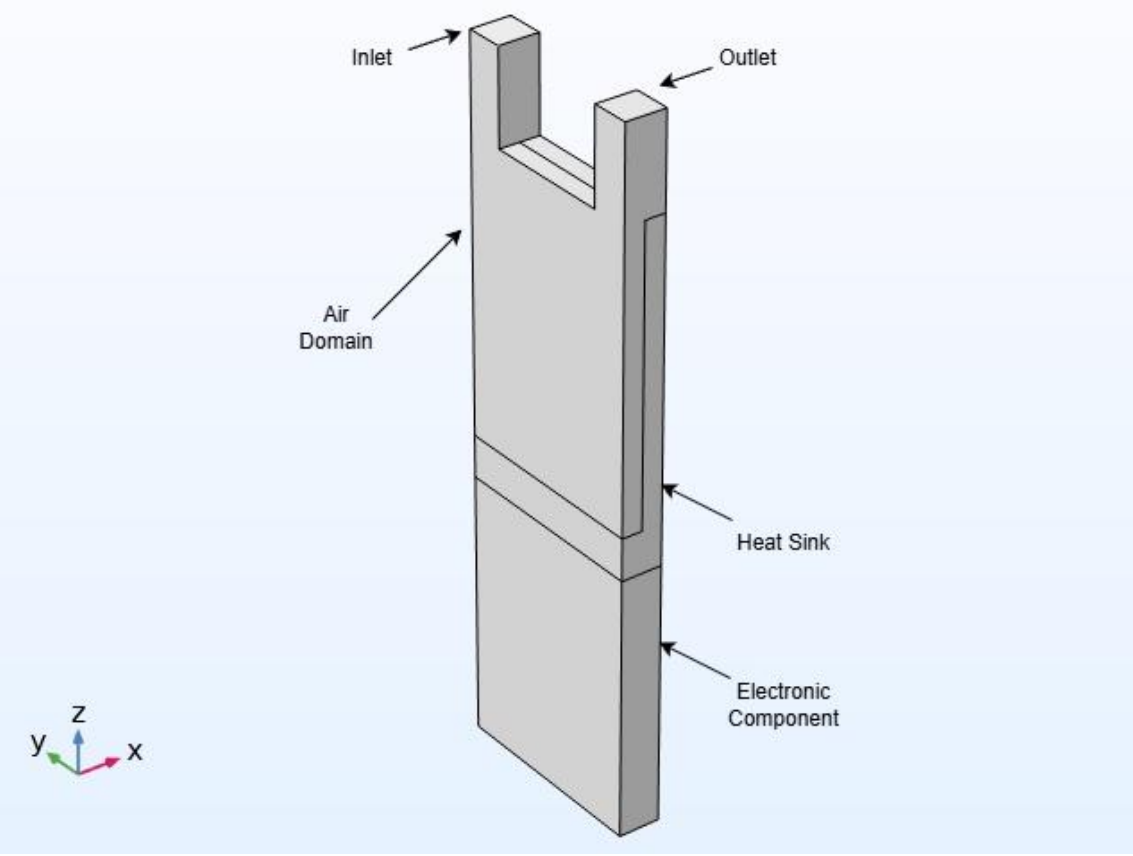
Our first joint case study focused on microchannel cooling for an electronic component.
Panejo developed the COMSOL model to capture the relevant thermal and fluid dynamics behavior. QUGATE then applied its intelligent design exploration approach to identify the most informative simulation cases, enabling the design space to be explored with fewer than 45 targeted simulation runs completed overnight.
Using a symmetry-based setup, flow rates were defined on a per-channel basis so that different designs could be compared consistently, while total flow and pumping effort still scaled realistically with channel count.
The results quickly revealed the key design trade-offs:
- Flow rate proved to be the dominant factor influencing component temperature, accounting for around 85% of the variation
- The interaction between channel depth and flow rate on pumping power was clearly identified
- A high-performance design region was found, achieving approximately 20°C lower temperatures than the unguided baseline
- Once the surrogate model was established, 10,000 design variants could be explored in seconds
One of the most striking outcomes was how quickly the study converged.
Although the original study could have required far more runs, the essential answer was already available after around 20 simulations. QUGATE’s analysis indicated convergence, and Panejo validated the result from a physics perspective. This gave us confidence not only in the final outcome, but also in knowing when enough data had been collected to move forward with decision-making.
This collaboration demonstrates the value of combining deep simulation expertise with intelligent exploration methods. The result is not only faster analysis, but greater confidence in the conclusions and a clearer path to engineering decisions.
We look forward to applying this approach to further engineering challenges together.
For more information, here is the full article: Microchannel Cooling Optimisation