Optimizing Microfluidic Mixing in Pharmaceutical Processes using Simulation
Understanding and controlling diffusion-driven mixing to improve product quality and reduce development time.
The Challenge
Modern pharmaceutical and biotech processes, such as lipid nanoparticle formulation or continuous drug manufacturing, increasingly rely on precise mixing at the microscale. At these scales, flow remains laminar, turbulence is absent, and mixing is governed mainly by diffusion. This makes process behavior highly sensitive to operating conditions and difficult to optimize experimentally.
Our Approach
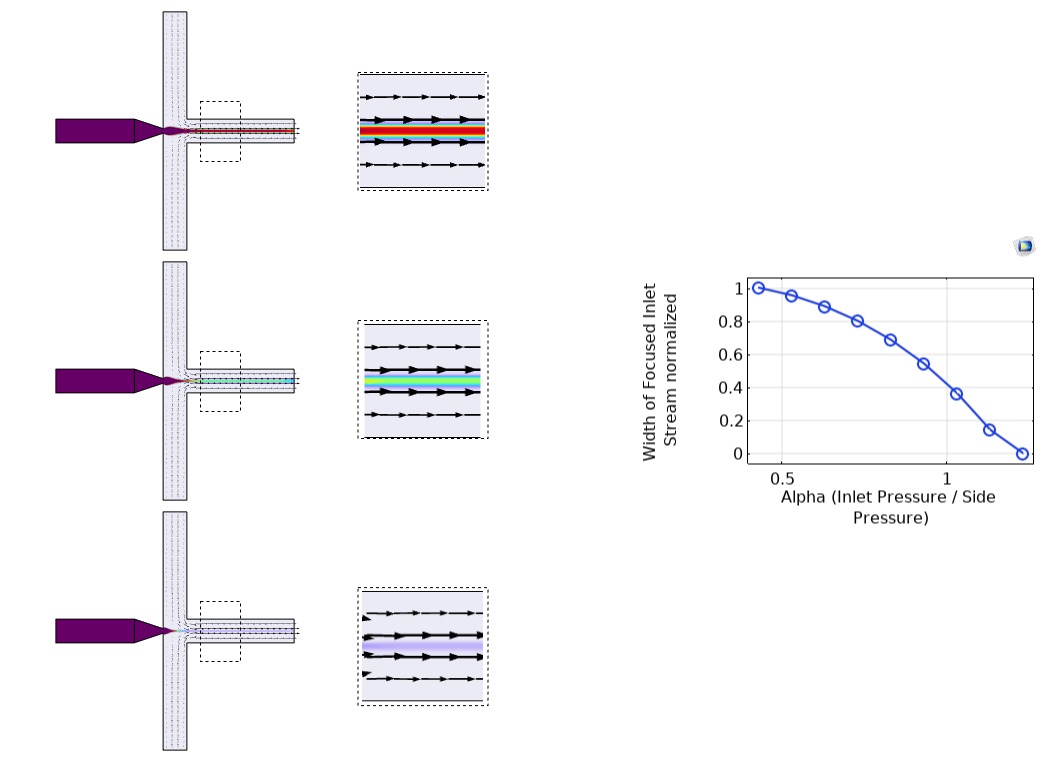
We developed a multiphysics simulation model of a microfluidic hydrodynamic focusing process, combining laminar flow and species transport. The model shows how flow ratios influence stream focusing, diffusion length, and downstream mixing behavior.
Key Insight
The simulation shows that mixing is not controlled by absolute flow rates alone, but by the ratio between interacting streams. By adjusting this ratio, the central stream can be compressed, diffusion distances are reduced, and mixing is accelerated.
Business Impact
These insights help pharmaceutical and biotech companies reduce experimental effort, lower material consumption of expensive reagents, shorten development cycles, and improve product robustness and consistency.
Why It Matters
Simulation makes invisible physical effects visible and helps teams make better engineering decisions before running costly experiments.